Overview
For an 8-DOF hybrid-joint redundant manipulator, a forward kinematic model is built and a conditional normalizing flow (CNF) learns the joint-configuration distribution conditioned on the end-effector pose. A single query yields multiple candidate inverse-kinematics (IK) solutions; after joint-limit, collision, and continuity filtering plus local pose refinement, the selected configurations feed Cartesian- and joint-space trajectory planning, and are tracked under control barrier functions (CBFs) in cluttered scenes.
Problem
A redundant manipulator has more joint degrees of freedom than the task-space dimension. For a 6-D end-effector pose , inverse kinematics of an 8-DOF system typically defines a positive-dimensional solution manifold rather than an isolated joint vector. Many configurations can realize the same pose; they are not equivalent under joint limits, clearance to obstacles, or continuity with the previous configuration.
Iterative numerical IK (for example damped least squares on the Jacobian) usually converges to one of those solutions and is sensitive to initialization. If that solution violates limits, collides, or jumps relative to the previous posture, the query fails or returns a configuration that cannot be executed.
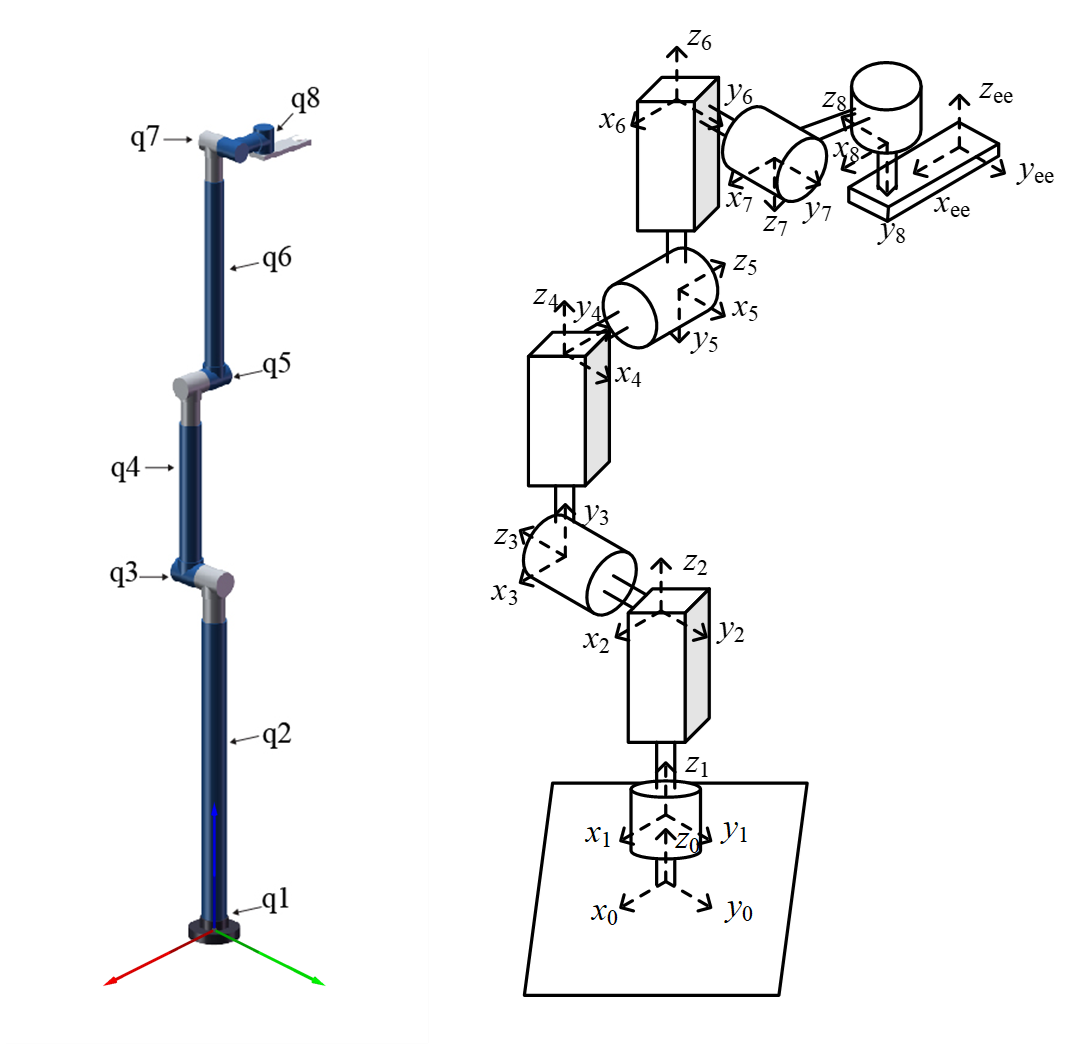
The platform here is an 8-DOF hybrid-joint redundant manipulator, with both revolute and prismatic joints. Hybrid joints complicate the forward map and the reachable workspace, and they make closed-form IK difficult to apply directly. Three questions have to be answered together:
- Does a feasible inverse solution exist for the commanded pose?
- If so, which candidate configurations in the solution family can planning use?
- After a configuration is chosen, how can a smooth, continuous, collision-aware trajectory be generated and tracked?
Method
The pipeline has four stages: generative IK, constrained selection and refinement, trajectory planning, and CBF tracking. The generative model proposes a solution family; deterministic constraints and the controller turn those samples into executable motion.
1. Conditional normalizing flow for IK
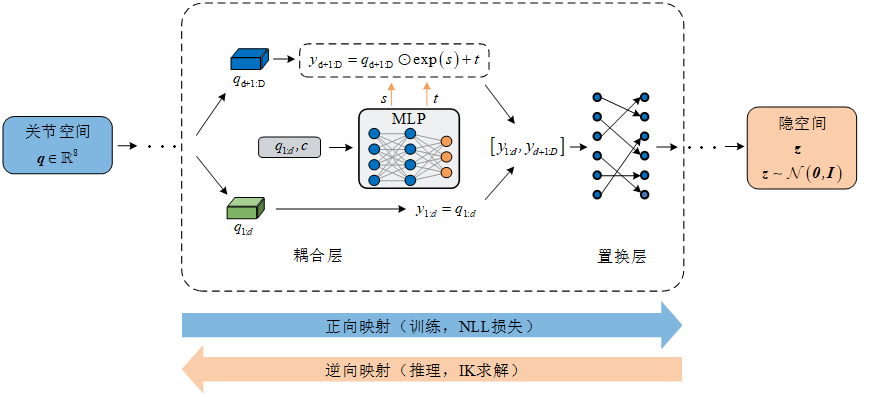
Let be the joint configuration and the conditioning pose. A CNF maps the joint space through invertible coupling and permutation layers onto a Gaussian latent space :
- Forward map (training): transform to and fit the data with a negative log-likelihood (NLL) loss.
- Inverse map (inference): sample and decode it to joint configurations, so one IK query returns multiple candidates.
Each coupling layer applies an affine transform , where the scale and translation come from an MLP on the remaining coordinates and the condition , preserving invertibility while introducing nonlinearity.
Training pairs are generated from forward kinematics: sample inside joint limits, compute the corresponding pose, and include workspace constraints so the network learns a conditional distribution of feasible configurations, not a single-point regression.
2. Constraint filtering and local refinement
CNF samples are candidates; they do not automatically satisfy every engineering constraint. Selection rejects or ranks them by:
- joint limits on both revolute and prismatic joints;
- collision-free geometry against workspace obstacles;
- motion continuity, i.e. a small joint-space distance to the previous configuration, to avoid posture jumps.
Selected solutions are then refined by local optimization to reduce the forward-kinematics residual to a pose error that planning can use. The generative model covers the solution family; numerical refinement recovers accuracy.
3. Trajectory planning
Planning is carried out in Cartesian and joint space. Inverse solutions after filtering become path nodes; a smooth, continuous, collision-aware trajectory is generated in a cluttered field so the manipulator can reach the target pose.
4. CBF-based safe tracking
Once a reference trajectory is available, the tracking layer constrains the control input with a control barrier function so that the safety function remains forward invariant: when , the rate is limited and the state cannot cross the safety boundary. In the demonstration, CBF is enabled (CBF=ON) and the controller is in tracking mode (state=TRACK).
CBF does not replace IK; it supplies a real-time collision-avoidance constraint during tracking.
Role
Independent work covering hybrid-joint kinematic modeling, CNF training and inference, constrained selection and refinement, trajectory planning in cluttered scenes, and the CBF tracking demonstration.
Evidence on this page
- Configuration and joint definition of the 8-DOF hybrid-joint redundant manipulator
- CNF coupling / permutation structure and the forward-train / inverse-IK path
- Screen recording of obstacle-field planning
- Screen recording of CBF tracking
Quantitative timing, pose-error, and comparison results are still being compiled. This page leads with the model, the pipeline, and motion evidence that can be inspected directly.
Skills
Python · Forward / inverse kinematics · Conditional normalizing flows · Redundant manipulators · Trajectory planning · Control barrier functions · Constrained optimization