Overview
For the first waist ring of a double-jib derrick, a global finite-element model of the mast is paired with a local contact model of the rollers against the angle-steel chords. Nine hoisting and wind cases are analysed. The worst original stress is in Case 9 (jib rotation 0°, wind 90°): a waist-ring von Mises peak of 121.80 MPa at the node-2 connecting plate. The roller count is then cut from 16 to 8 and each connecting plate is reduced to a single bolt hole. A Kriging surrogate of the peak stress under the governing case is searched with the Grey Wolf Optimizer (GWO) over outer diameter 30–37 mm and wall thickness 3–5 mm, minimizing main-member volume. The optimum section is 32.398 mm OD by 3 mm wall; the single-component mass falls by 2.88 kg relative to the original ring.
Problem
A waist ring is the transition member between the derrick and the tower-constraint system. It carries lateral load, limits mast drift, and redistributes guy-wire tension. The critical spots are rarely at mid-span of the pipes; they sit at the rollers, the connecting plates, and the contacts with the mast angle steel. As the jibs pitch and yaw, the hoist goes eccentric, and the wind direction changes, contact pairs open and close. A beam-only internal-force formula does not locate those peaks.
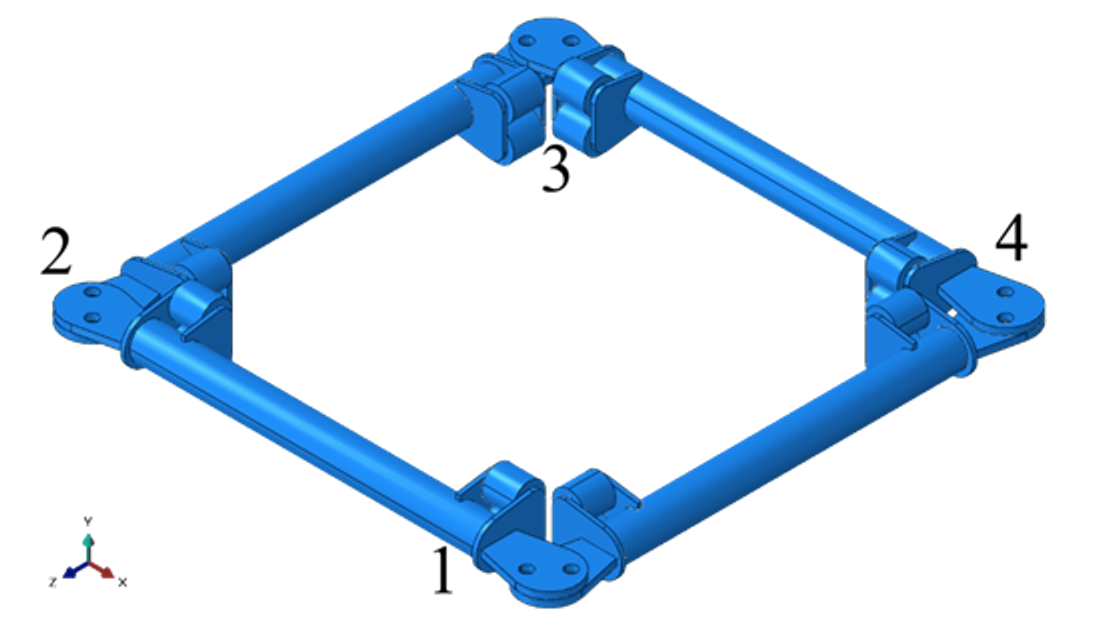
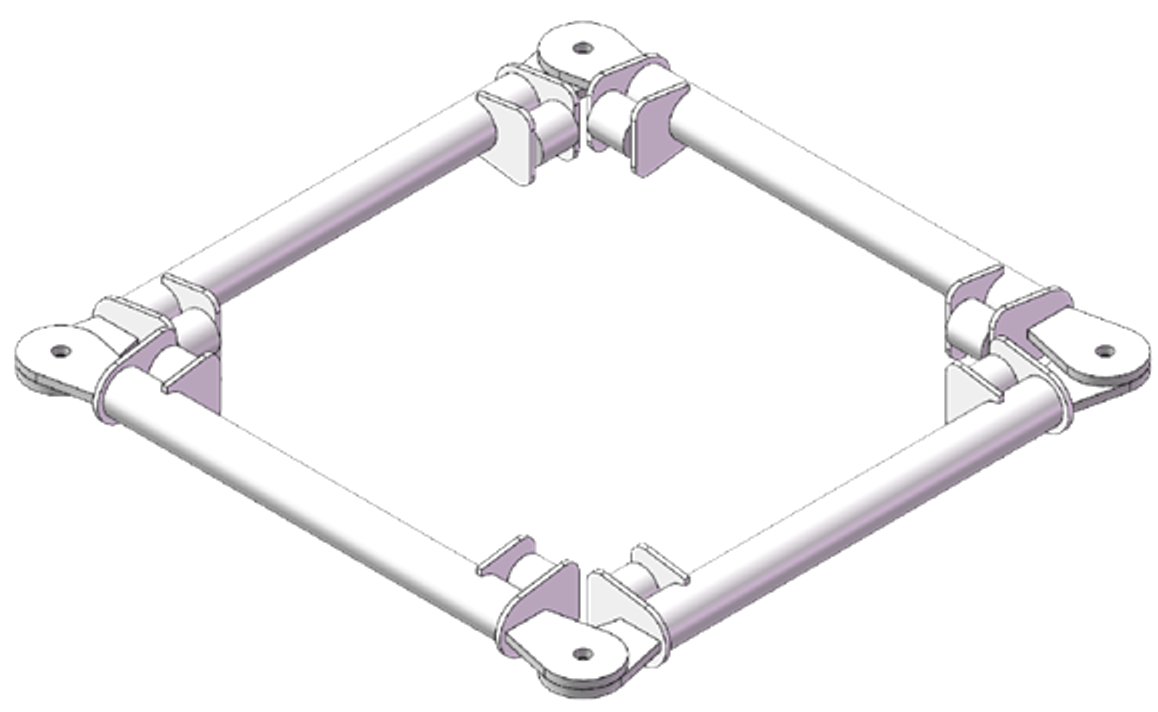
The object of this work is the first waist ring of a double-jib derrick. The mast section is 500 mm × 500 mm and the total height is 72 m, with inner guys and seven waist rings. The ring itself is four seamless steel pipes closed by connecting plates, with 16 rollers on the outer perimeter. The rated lift is 2 × 1.5 t in tandem. The working-state wind speed is 13.8 m/s; the out-of-service wind speed is 28.4 m/s.
Three questions have to be answered together:
- under unbalanced hoist, jib rotation and wind, which case governs, and is the hot spot global or local-contact;
- after the roller count and plate holes are reduced, where the stress peak moves;
- subject to the strength constraint, which pipe outer diameter and wall thickness cut the single-piece mass.
The deliverable is the ring, not the tower: multi-scale finite-element analysis, a shape simplification, and a surrogate-driven section search.
Method
The sequence is global identification, local contact, shape simplification, then surrogate search. Guy-wire reactions from the global model become the boundary of the local contact model; geometry and section are changed only after that.
1. Global model and local contact model
The global model uses beam elements (BEAM188) for the mast, bridge and jib angle steel, and LINK10 for the waist-ring ropes and inner guys. Joints are rigid; rotation about the jib pin is released by a DOF coupling so the motion is closer to the real hinge. The global run supplies stresses, displacements and guy tensions, and passes the four guy forces of the first waist ring into the local model.
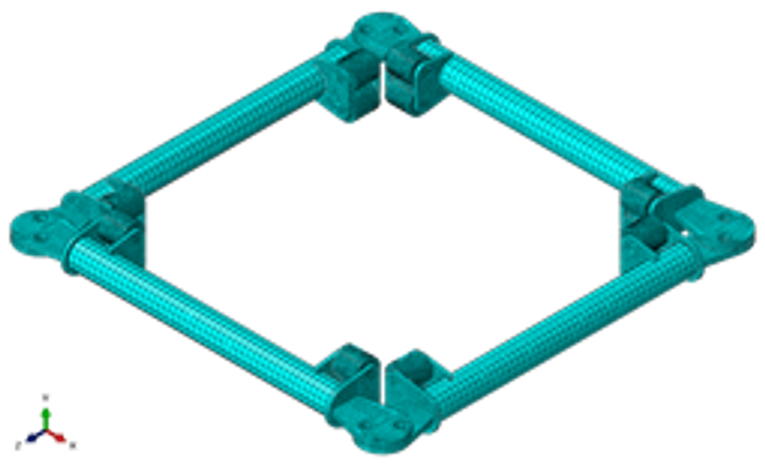
The local model resolves contact among rollers, connecting plates, the pipe members and the mast angle steel. The original 16 rollers give 16 frictional pairs, surface-to-surface, friction coefficient 0.2. The roller face is the contact side and the angle-steel face the target, because the roller is the more flexible of the two. Most of the remaining interfaces are tied.
Wind load follows GB/T 3811—2008. Nine cases are used: Cases 1–8 combine jib elevation (3° / 87°), yaw (0° / 45°) and hoist symmetry; Case 9 is the unloaded storm (28.4 m/s). The working-state yield and stability factors of safety are 2.0; the special-wind yield factor is not less than 1.45. Hoist-impact and dynamic factors on payload and self-weight are both 1.1. Checks also follow DL/T 319—2018 and DL/T 875—2016.
2. Governing cases and the original response
Across the set, Case 3 is the unbalanced-hoist extreme and Case 9 the storm-unloaded extreme. They fail differently: eccentricity hurts the mast diagonals more; lateral wind hurts the waist-ring plates more.
| Case | Wind / pose | Waist-ring von Mises peak | Location | Mast-section peak |
|---|---|---|---|---|
| Case 3 | 90° wind | 96.80 MPa | node-3 connecting plate | 115.90 MPa (diagonal) |
| Case 9 | jib 0°, 90° wind | 121.80 MPa | node-2 connecting plate | 88.12 MPa (diagonal) |
| Case 9 | jib 45°, 90° wind | 97.52 MPa | node-2 connecting plate | 56.93 MPa (diagonal) |
In Case 9 with jib 45° and wind 90°, the node-3 guy tension reaches 5947.5 N, one of the tension peaks; the global stress maxima of ring and mast occur instead at jib 0° and wind 90°. The maximum-force case is not the maximum-stress case. Watching guy tension alone misses the plate and contact peaks.
Waist-ring displacements in the three representative states are 3.795 mm, 3.830 mm and 3.890 mm, all within 4 mm.
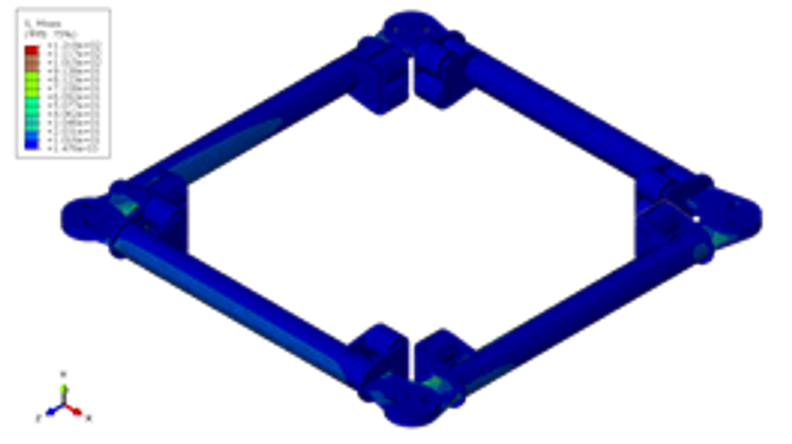
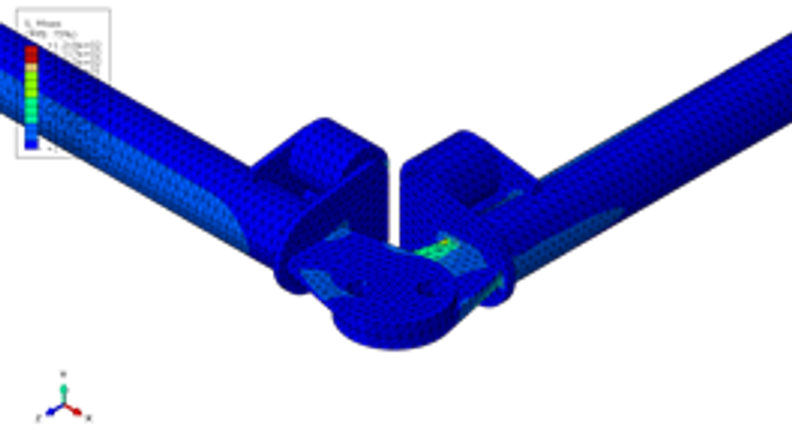
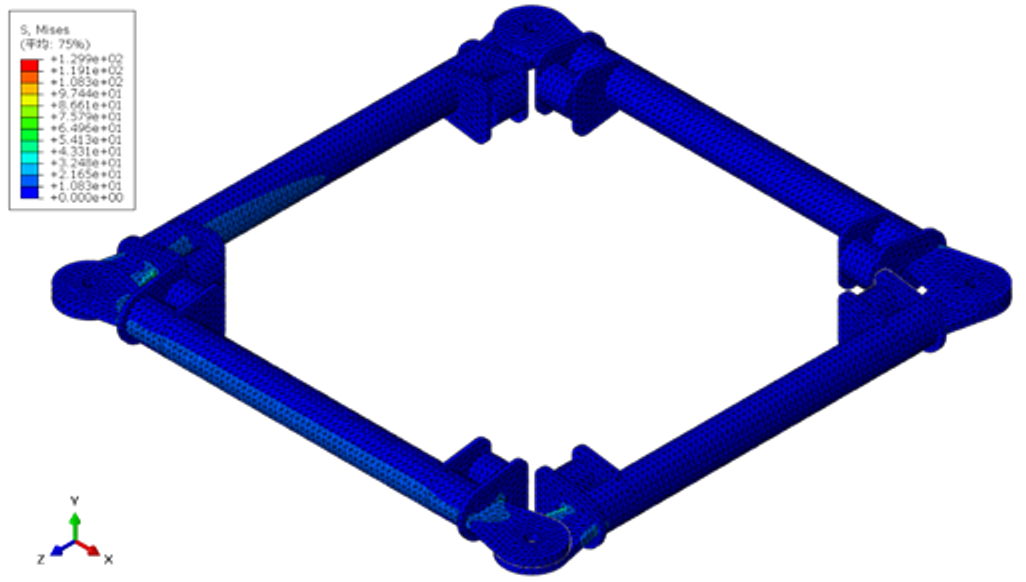
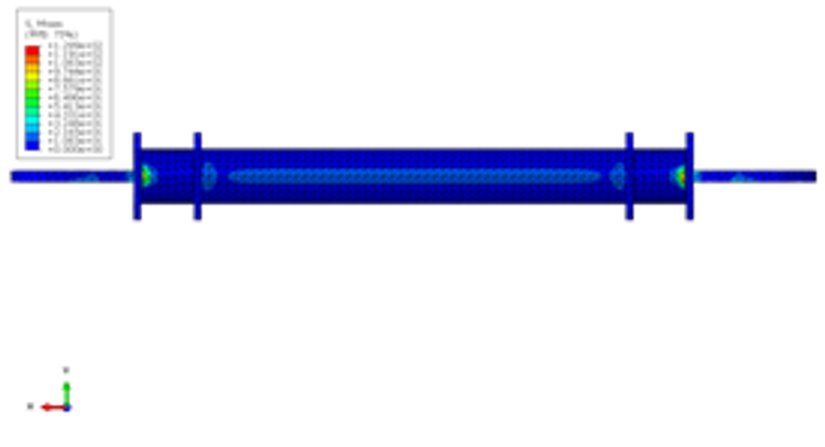
The colour bars on the screenshots are not labelled with a readable peak. The table values are taken from the analysis report, not estimated from pixels.
3. Shape change: fewer rollers, simpler holes
Vertical-direction rollers are loaded very unevenly, and some connections are conservative relative to the material capacity. The shape change is 16 → 8 rollers and one bolt hole per connecting plate. Function is kept; mass and fabrication complexity drop first.
Verification reuses Cases 3 and 9, applying the original global guy forces to the new local model. In the comparison sample, points 1 and 2 carry no tension; points 3 and 4 carry 4314.7 N and 4332.6 N.
Under Case 9 with jib yaw 0°:
- the waist-ring von Mises peak moves from 121.80 MPa at the connecting plate to 129.90 MPa at a load-bearing roller;
- the mast-section peak falls from 88.12 MPa to 86.76 MPa.
The peak is not shaved down; it is moved onto a member that is meant to carry contact and is easier to inspect and replace. The load path is shorter, and material sits where it is actually used.
4. Kriging surrogate and GWO section search
With the shape fixed, the seamless-pipe section is treated as a continuous design. Variables are outer diameter 30–37 mm and wall thickness 3–5 mm. The response is the first-ring von Mises peak under the governing case. Samples are generated by a design of experiments, solved in the finite-element model, and fitted with Kriging:
where is the regression term and a Gaussian-correlated process.
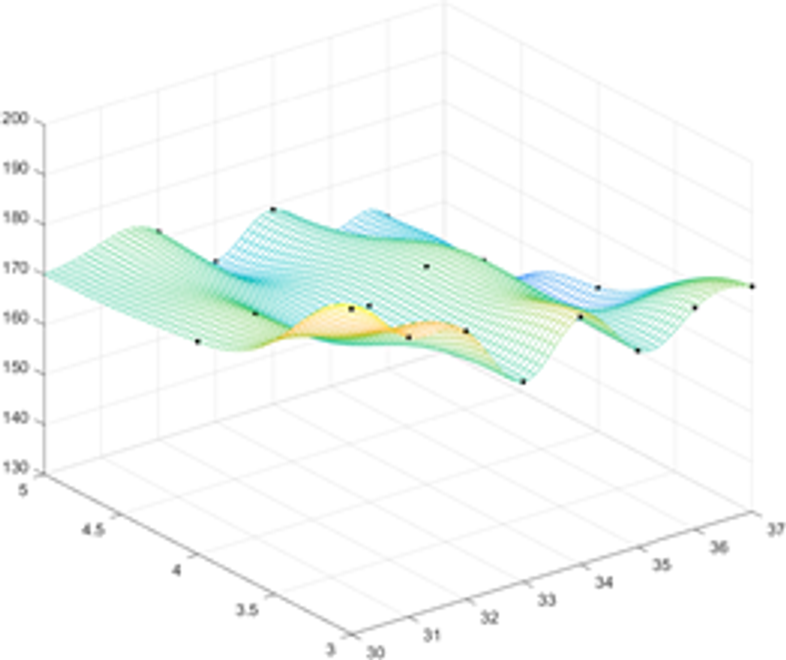
Grey Wolf Optimizer then searches that surface: minimize pipe volume subject to the stress constraint. Population 50, maximum 1000 iterations. Exploration is strong at the start and the run levels off after about 150 generations. The optimum is 32.398 mm outer diameter and 3 mm wall; the report quotes a predicted volume of 582.4143 mm³. At that section the single-component mass of the waist ring is 2.88 kg below the original.
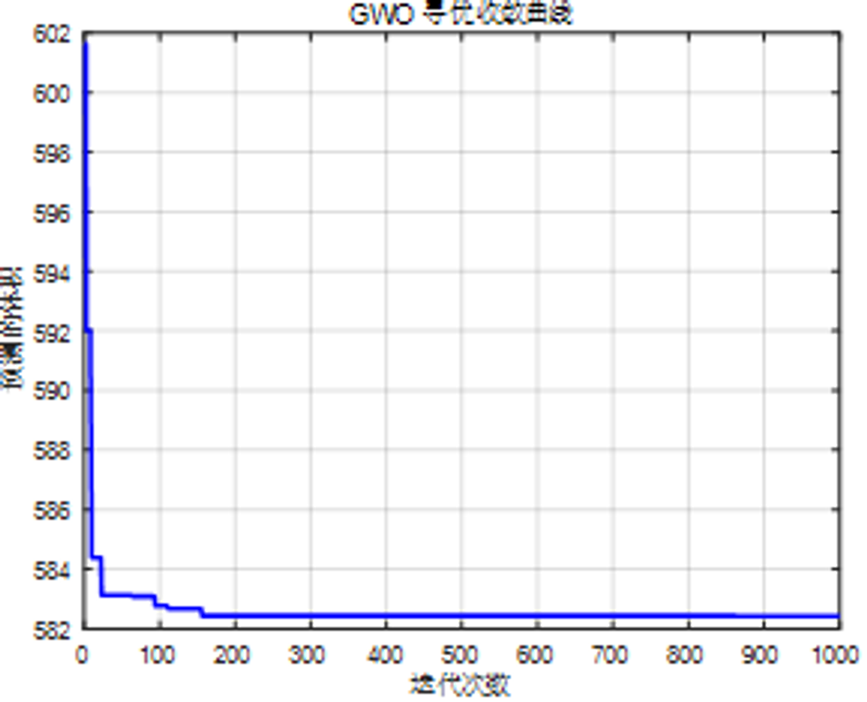
This is volume minimization with a stress constraint, not a Pareto front on strength, stiffness and mass. Stiffness of the original ring was checked by the displacement peaks (below 4 mm) and was not placed in the GWO objective.
Role
Responsible for the global derrick model and the local waist-ring contact model, the multi-case load set and governing-case identification, the fewer-roller / simpler-hole shape change, and the Kriging plus GWO section search.
Evidence on this page
- Original geometry, mesh and stress contours (peaks from the report; the screenshots are unlabelled)
- Shape-optimized model and stress contours: peak moves from the connecting plate to a load-bearing roller (121.80 → 129.90 MPa)
- Kriging surface and GWO history
- Optimum section 32.398 mm OD × 3 mm wall, single-component mass reduction 2.88 kg
Allowable stresses and factors of safety after optimization are not tabulated here. Displacements and stresses are case peaks from the report, not a full load spectrum.
Skills
Contact nonlinearity · Multi-scale FEA · Abaqus · Kriging · Grey Wolf Optimizer · Shape simplification · Lightweight structures